


Share
Table of Contents
Beginning
What Does “Normal” Discharge Look Like?
What Does “Abnormal” Discharge Look Like?
3 STIs And “Abnormal” Discharge: What to Look For
Diagnosing, Treating, and Protecting Against STIs
Stay Up-to-Date On Your Sexual Health
Medically reviewed by Jillian Foglesong Stabile, MD, FAAFP, DABOM, on June 1, 2026
To give you technically accurate, evidence-based information, content published on the Everlywell blog is reviewed by credentialed professionals with expertise in medical and bioscience fields.As any woman or person assigned female at birth (AFAB) knows firsthand, vaginal discharge is a pretty common occurrence. In fact, it’s a sign—and function—of physical health: vaginal discharge helps keep the vagina clean and free of harmful pathogens. To that end, noticing something “off” about your usual patterns may indicate your immune system is overburdened, or your body is dealing with an underlying health issue. Whether it’s an unusual odor or your discharge has a strange color, it’s important to know if it’s a sexually transmitted disease causing changes so you can get treated as soon as possible.
What Does “Normal” Discharge Look Like?
Think of vaginal discharge as the ordinary housekeeping your vagina carries out to maintain itself and stay healthy. During this process, the cervix sheds a combination of:
- Vaginal cells
- Cervical mucus
- Vaginal fluids
Together, they form a white or translucent substance: healthy vaginal discharge. But even healthy vaginal discharge goes through fluctuations over the course of the menstrual cycle and even over the course of a lifetime. [1]
For instance [1]:
- Ovulatory vaginal discharge tends to be clear and gummy, making it easier to trap and lure sperm toward an ovulated egg.
- When discharge is thin, opaque, or tacky, it’s usually a sign you’re outside of your fertile window.
Under healthful conditions, discharge carries little more than a mild odor, if any at all.
Moreover, it’s produced in relatively small amounts, though volume increases slightly during ovulation.
What Does “Abnormal” Discharge Look Like?
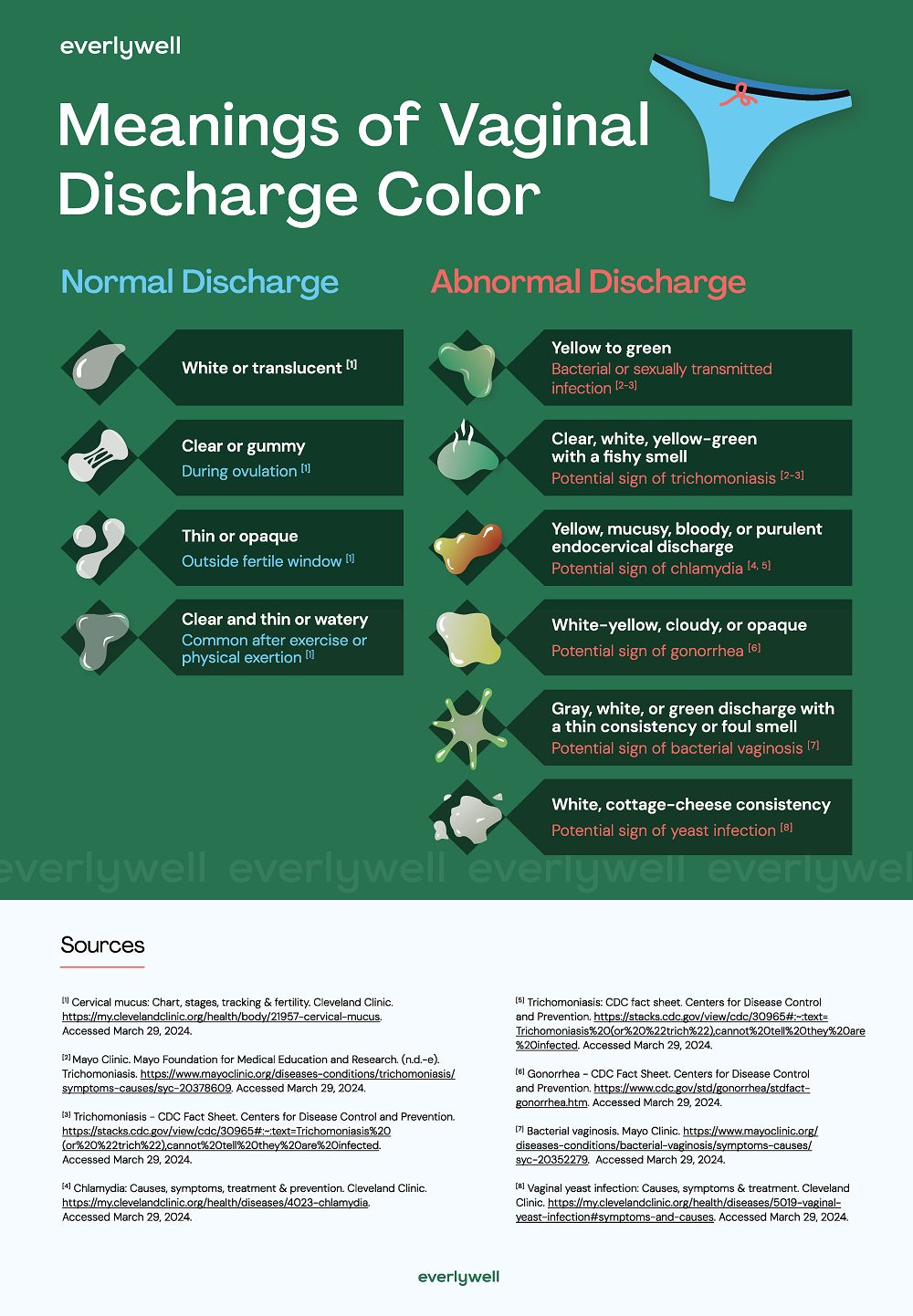
The first step in identifying STD discharge or STI discharge is to determine if it's abnormal. One of the clearest signs you may need to seek out a healthcare provider is if your discharge has an unusual color.
3 STIs And “Abnormal” Discharge: What to Look For
Three STIs, in particular, are known to cause observable changes in what a woman's discharge looks like:
- Trichomoniasis: A common STI caused by a parasite. When symptoms do appear — in roughly 30% of cases — women may notice thin or frothy discharge that's white, yellow, or greenish in color, often with a foul odor. Other signs can include soreness or redness around the vaginal opening and pain during sex or urination. The CDC cautions that approximately 70% of people infected do not show any symptoms. [6]
- Chlamydia: A very common bacterial STI — between 50% and 70% of people who have it never notice symptoms. When symptoms do appear in women, they may include white, yellow, or gray vaginal discharge that may have an unpleasant odor, along with burning when urinating, bleeding between periods, or pain during sex. Left untreated, a chlamydial infection can seriously damage a woman's reproductive system, including raising the risk of pelvic inflammatory disease and permanent infertility.
- Gonorrhea: Often appears alongside chlamydia. In women, it typically causes yellow or greenish vaginal discharge, burning pain when urinating, and lower abdominal pain. Gonorrhea won't go away on its own — if left untreated, it can lead to pelvic inflammatory disease and infertility.


Diagnosing, Treating, and Protecting Against STIs
Because many STIs produce no noticeable symptoms, a change in vaginal discharge is sometimes the first visible sign that something is off. Vaginal discharge disturbances can have many causes, but if you notice something is amiss, one of the best things you can do is screen for multiple common STIs at once — co-infections like chlamydia and gonorrhea together are not uncommon.
Bacterial STIs — including chlamydia, gonorrhea, and trichomoniasis — are all treatable with antibiotics. Treatment clears the infection, but it cannot reverse damage that occurred before treatment began, which is why early detection matters. Your sexual partners should also be tested and treated at the same time to avoid passing the infection back and forth.
When it comes to prevention, using condoms during vaginal, anal, and oral sex reduces — but does not eliminate — the risk of transmission. Safe sex practices, limiting the number of sexual partners, and talking openly with partners about STI status are all steps that can lower your risk. Consistent testing remains a key part of sexual well-being.
Stay Up-to-Date On Your Sexual Health
If you notice unusual vaginal discharge, consulting with a healthcare provider can help determine the cause and appropriate treatment options.
You can order an at-home STD test through Everlywell to screen for multiple common infections from the privacy of home.
- Professional, C. C. medical. (n.d.-a). Cervical mucus: Chart, stages, tracking & fertility. Cleveland Clinic. https://my.clevelandclinic.org/health/body/21957-cervical-mucus
- NHS. Vaginal discharge in pregnancy. https://www.nhs.uk/pregnancy/related-conditions/common-symptoms/vaginal-discharge/. Accessed June 1, 2026.
- France M;Alizadeh M;Brown S;Ma B;Ravel J; (n.d.). Towards a deeper understanding of the vaginal microbiota. Nature Microbiology.
- Mayo Foundation for Medical Education and Research. (2023c, April 25). Vaginal discharge causes. Mayo Clinic. https://www.mayoclinic.org/symptoms/vaginal-discharge/basics/causes/sym-20050825
- Mayo Foundation for Medical Education and Research. (n.d.-e). Trichomoniasis. Mayo Clinic. https://www.mayoclinic.org/diseases-conditions/trichomoniasis/symptoms-causes/syc-20378609
- Trichomoniasis - CDC fact sheet. Centers for Disease Control and Prevention. https://www.cdc.gov/std/trichomonas/stdfact-trichomoniasis.htm. Accessed June 1, 2026.
- Professional, C. C. medical. (n.d.-b). Chlamydia: Causes, symptoms, treatment & prevention. Cleveland Clinic. https://my.clevelandclinic.org/health/diseases/4023-chlamydia
- Chlamydia statistics. Centers for Disease Control and Prevention. https://www.cdc.gov/std/chlamydia/stats.htm. Accessed June 1, 2026.
- Mayo Foundation for Medical Education and Research. (2023b, April 14). Gonorrhea. Mayo Clinic. https://www.mayoclinic.org/diseases-conditions/gonorrhea/symptoms-causes/syc-20351774
- Gonorrhea - CDC fact sheet. Centers for Disease Control and Prevention. https://www.cdc.gov/std/gonorrhea/stdfact-gonorrhea.htm. Accessed June 1, 2026.
- Mayo Foundation for Medical Education and Research. (2023d, April 25). Vaginal discharge causes. Mayo Clinic. https://www.mayoclinic.org/symptoms/vaginal-discharge/basics/causes/sym-20050825
- Mayo Foundation for Medical Education and Research. (2023f, June 10). Bacterial vaginosis. Mayo Clinic. https://www.mayoclinic.org/diseases-conditions/bacterial-vaginosis/symptoms-causes/syc-20352279
- Mayo Foundation for Medical Education and Research. (n.d.-c). Pelvic inflammatory disease (PID). Mayo Clinic. https://www.mayoclinic.org/diseases-conditions/pelvic-inflammatory-disease/symptoms-causes/syc-20352594#symptoms
- Professional, C. C. medical. (n.d.-x). Vaginal yeast infection: Causes, symptoms & treatment. Cleveland Clinic. https://my.clevelandclinic.org/health/diseases/5019-vaginal-yeast-infection#symptoms-and-causes
- Mayo Foundation for Medical Education and Research. (2023k, September 8). Sexually transmitted diseases (STDs). Mayo Clinic. https://www.mayoclinic.org/diseases-conditions/sexually-transmitted-diseases-stds/diagnosis-treatment/drc-20351246
- Gonorrhoea. NHS. https://www.nhs.uk/conditions/gonorrhoea/. Accessed June 1, 2026.
- Professional, C. C. medical. (n.d.). Trichomoniasis. Cleveland Clinic. https://my.clevelandclinic.org/health/diseases/4696-trichomoniasis. Accessed June 1, 2026.
Share
Table of Contents
Beginning
What Does “Normal” Discharge Look Like?
What Does “Abnormal” Discharge Look Like?
3 STIs And “Abnormal” Discharge: What to Look For
Diagnosing, Treating, and Protecting Against STIs
Stay Up-to-Date On Your Sexual Health
Spotlight on
Breast Cancer Awareness Month


Your mammogram looks for cancer today. What about tomorrow? A new way to look at your breast cancer risk.
Learn more


When it comes to cancer, early is everything. Screen for early signs on 55+ cancers with a single blood draw.
Know earlyYour mammogram looks for cancer today. What about tomorrow? A new way to look at your breast cancer risk.
Learn moreWhen it comes to cancer, early is everything. Screen for early signs on 55+ cancers with a single blood draw.
Know earlyExplore Everlywell


